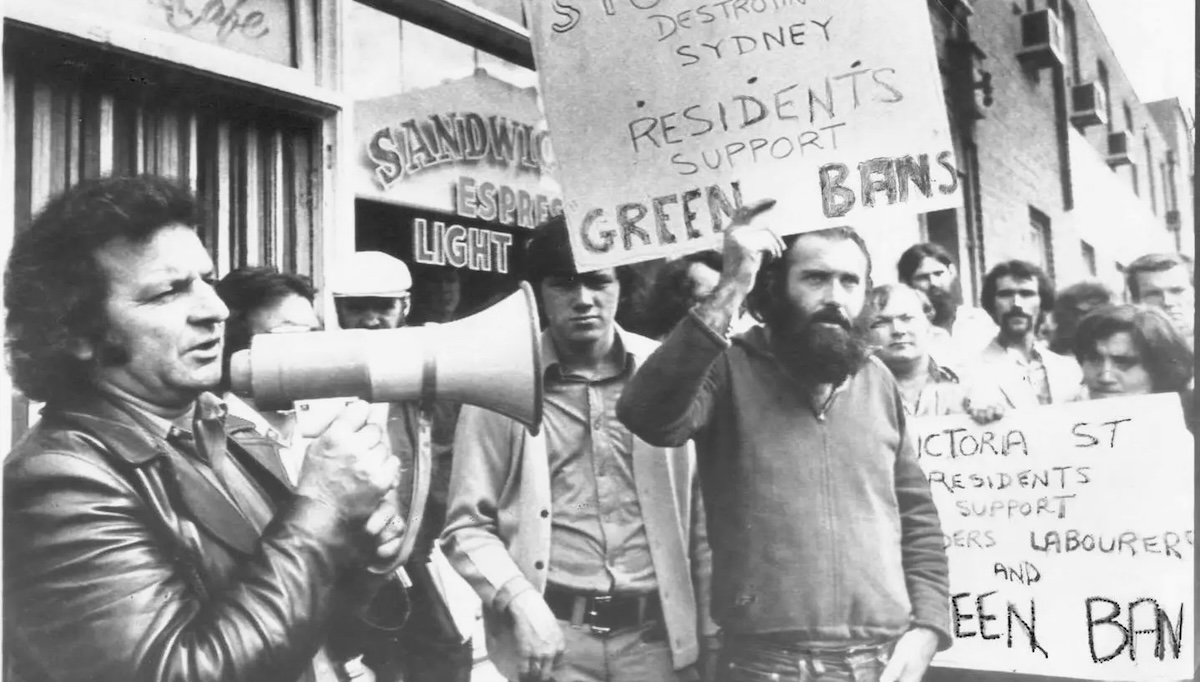
Jack Mundey was one of the key figures behind Sydney’s Green Bans movement. A builder’s labourer and Secretary of the NSW Builders’ Labourers Federation from 1968 to 1975, he became a powerful voice for protecting Sydney’s historic buildings, neighbourhoods and communities from unchecked development.
The Green Bans are remembered for saving places such as The Rocks, Woolloomooloo and Glebe from demolition, along with important buildings including the State Theatre, Pitt Street Uniting Church and the Royal Australasian College of Physicians building in Macquarie Street.
But the movement was about more than buildings. Mundey and the BLF argued that development should take account of the people who lived in these neighbourhoods. The Green Bans helped protect low-cost rental housing, prevent evictions and preserve established communities from being broken up.
Mundey remained an active environmental and heritage campaigner throughout his life. He later served on Sydney Council, represented resident action groups and became a councillor of the Australian Conservation Foundation. He was also appointed Chair of the NSW Historic Houses Trust and was made an Officer of the Order of Australia in 2000.
Jack Mundey died in 2020 aged 90. The excerpt below is from a speech that Jack made to the Paddington Society’s AGM at the EJ Ward Centre in 2001.
The community remains indebted to Jack and his colleagues at the BLF for all that they achieved, and preserved for future generations.
“Thank you for inviting someone from the Western Suburbs to address you. Your Society is very impressive, having been in existence for nearly 40 years, especially when you consider how recent the “environment” is. The first EVER international conference on the environment was held in Stockholm in 1972, when the planet was already well on the way to being ravaged. And that conference more or less ended in a brawl, as the urban conservationists and the nature conservationists could not agree. Cities in the world were then, and are now, getting out of control.
By the way, EJ WARD, whose name graces this Centre, was a very fiery speaker, one to the few who used to rattle Menzies, during his sixteen year reign. One of his jibes was “A promising military career was cut short by the outbreak of war” referring to Menzies’ failure to enlist.
The start of my activism was in the trade union movement. Up to 1957 the height limit for building in the city was 150ft. This limit was then removed entirely, and 1959-75 saw the biggest ever building boom in central Sydney. This was called “progress”. The AMP building was finished in 1961 and was so much admired that they charged six bob to climb up it and look at the view. But resident action groups began to stir, arguing that biggest was not necessarily best and that history was important.
The Builders’ Labourers Federation (BLF) consisted of unskilled workers, many of whom were at this time dying on the job owing to lack of safety regulations and unsafe practices. The BLF also fought for women’s right to work, raised the subject of black rights and we fought against Vietnam and apartheid. Progressive unions must be not only concerned with wages but must consider the environment and social issues.
At this time a group of middle-class women in Hunters Hill were arguing against the developers AV Jennings for demolishing the last bushland, Kellie’s Bush on the Parramatta River in order to commence construction. They asked the BLF for a ban. This was the first of 43 bans, and the union simply reacted to residents’ concerns. The Askin government of course was pro-development.
AV Jennings was also building on a site in North Sydney, so our line was that no work would proceed there until Kelly’s Bush was preserved. When the Wran government came in, Kelly’s Bush was dedicated as open space. We also refused to allow the destruction of 3 old fig trees in the Domain when the Domain parking station was being constructed. The chief of staff at the Sydney Morning Herald told me that he’d had more letters on those fig trees than any other issue.
There was and remains, a strange mixture of people across all political beliefs. Many people thought the union was “going too far”, but the residents supported us. Centennial Park was saved, and another threat a year or two ago from Macdonalds was averted. Unfortunately unions are no longer engaged in this way today – perhaps if they were they would improve their membership.
In the end we in the BLF were smashed. The developers were feeding huge secret commissions to the governments, much more than the unions ever donated to the ALP. In Victoria a group has been formed called “Earthworker”, fighting for a sustainable economy in an ecologically sound society. We need to become a conserver society, not consumer society. But it is good to know that all our actions, so despised and vilified at the time, are now vindicated.
The next challenge will be the MSB building at the Rocks. The corporate sector is very strong now, and residents’ groups are more important than ever. We must bring back the connecting links. Remember, there are 80 buildings still standing in Sydney today which could other wise have been destroyed.
Individuals must take action. The Land & Environment Court at its inception, under Judge Jim McClelland, was very good. We must pressure parliament to reform it. Twenty-five years ago there was a very high level of corruption – I could have been living in Paddington today if I’d accepted all the bribes I was offered then.
Today the Labor Party receives four times as much funding from corporations and developers as it gets from the unions. For me, the biggest single problem today is the motor car. 40% of Sydney’s land is devoted to roads, freeways, driveways etc. And the cars which use all this land are themselves only in use for 3% of their time. It makes no sense.”
Jack Mundey AO