Update 6 October 2026
NSW Planning have extended the exhibition of the Edgecliff-Woollahra State-led Rezoning Proposal to give the community more time to review the proposal and provide feedback. The exhibition period will now close at 5pm, 30 October 2026.
For more information contact 1300 305 695, email edgecliff.woollahra@planning.nsw.gov.au
The Society’s submission will be available shortly, please also read the submission kindly supplied by Andrew Andersons.
Andrew has been the Assistant Government Architect and a Director of a large commercial firm, Peddle Thorp and Walker, now PTW, retiring 12 years ago. In these 63 years he has presided over numerous civic and urban design projects such as Circular Quay improvement, Walsh Bay development, Barangaroo, Central Park and Woolloomooloo Finger Wharf and has designed numerous apartment buildings, ranging from luxury developments in the City of Sydney, Bondi and Double Bay to more affordable schemes in locations such as Rhodes and Rosebery.
Also listen to Elizabeth Farrelly joined by urban experts Andrew Andersons AO (Fmr Asst Govt Architect) & Prof. Philip Thalis (AIA Gold Medallist) and Mayor of Woollahra Sarah Dixson on The Sydneyist on Eastside Radio.
21 September 2026
The NSW Government has released more information on their proposal to rezone land around the existing Edgecliff Station and the future Woollahra Station under the State Significant Rezoning Policy. Woollahra Municipal Council has also shared an alternative approach for the area (see below).
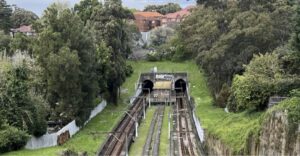
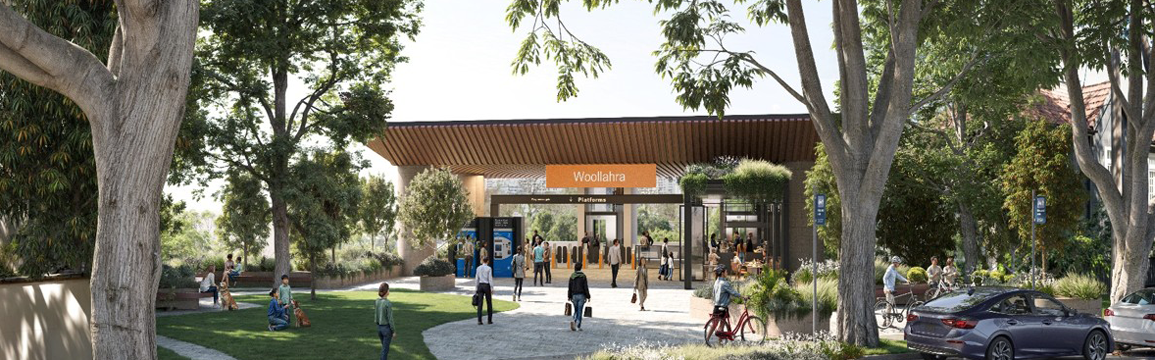
Proposed Woollahra Station
The NSW Government draft Edgecliff-Woollahra Precinct State-led Rezoning Proposal seeks to amend the planning controls in the Woollahra Local Environmental Plan 2021 (WLEP) to enable the delivery of more homes close to public transport, jobs, services and open space.
The draft proposal supports a state-wide approach to increasing housing supply and diversity, creating more opportunities for people to live near Sydney’s inner city.
NSW Planning Department summary of key features of the draft proposal include:
- approximately 9,400 new homes, with an affordable housing contribution base rate of 3% in perpetuity, increasing up to 15% for certain sites
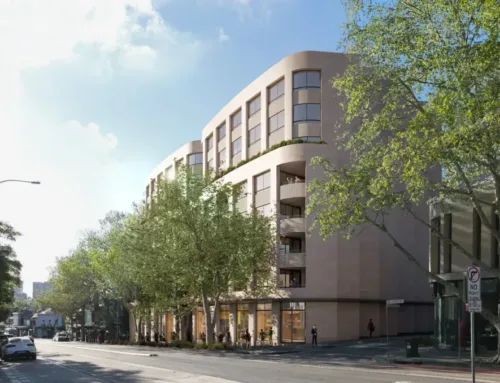
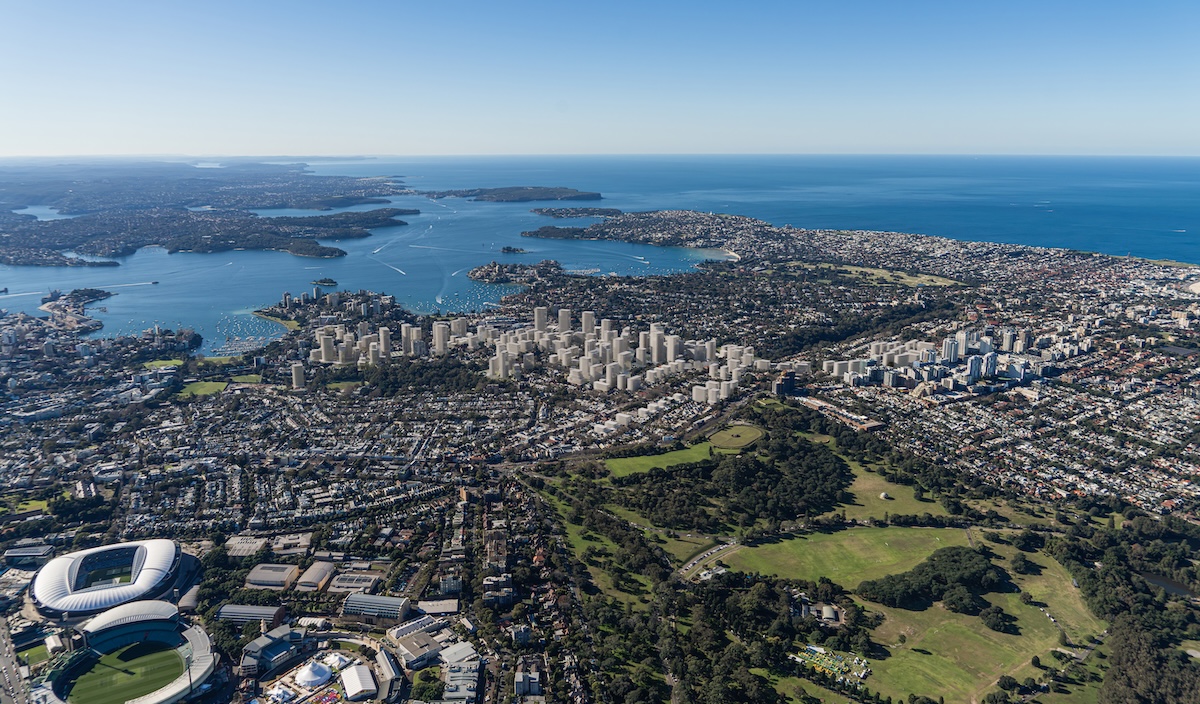
- higher-density housing and commercial spaces of up to 34 storeys around Edgecliff Station and 32 storeys around Woollahra Station
- a larger retail centre at Edgecliff and a new Woollahra local centre, creating up to 1,000 jobs and providing additional community facilities and services
- retention and integration of local heritage items into the surrounding areas
- approximately 3.5 hectares of new and upgraded public open space across 13 parks (7 new parks, 6 existing parks) and a plaza
- improved connections throughout the Precinct with up to 9km of new walking and cycling paths
- planning controls that promote retention of tree canopy and provision for more landscape features.
Read the Edgecliff -Woollahra Precinct Draft Design Guide published in September 2026 by the NSW Government Department of Planning, Housing and Infrastructure and the Explanation of Intended Effect.
For more information call 1300 305 695, email edgecliff.woollahra@planning.nsw.gov.au or refer to the frequently asked questions under ‘Resources’.
You can also visit the Department’s website to register for a community drop-in session.
You can also visit a local session at Paddington Library, details as follows:
⏰6:30-8.00PM
🗓️Tuesday, 22 September;
🗓️Tuesday, 29 September
📍Paddington Library
Most importantly, if you wish to voice your opinion please submit your feedback by 5pm, Wednesday 7 October, 2026. Feedback received during the exhibition period will inform the finalisation of the proposal, with an outcome expected in 2027.
When making your submission, you may wish to address the following issues:
Traffic and transport:
- The area already has congestion, steep streets, constrained footpaths and limited cycling infrastructure.
- The State’s modelling relies on significant changes in travel behaviour, but the government has not committed to funding essential transport improvements.
- Not one new bus route is proposed.
- The State’s traffic plan is based on a google-maps desktop assessment, not a credible traffic study.
- Request detailed local traffic modelling and a clear plan to manage cumulative impacts.
Infrastructure:
- The State’s Infrastructure Delivery Plan identifies approximately $1.33 billion in infrastructure costs, including:
- 2,200 square metres of community facilities;
- 730 square metres of arts and cultural space;
- 1,250 square metres of library space;
- 530 early-childhood places;
- 920 out-of-school-hours-care places;
- 1,430 additional primary school students;
- 1,020 additional high-school students;
- The State has not considered additional aged care facilities notwithstanding Woollahra’s high demographics of seniors.
- There are no new hospitals proposed, no new primary schools and no high school proposed.
- The State government has given no commitment to funding this essential infrastructure.
- Ask for infrastructure to be fully funded, staged and delivered alongside new development.
Open space:
- The precinct already has a deficiency of public open space, and existing parks and recreation facilities are under pressure.
- The State proposes approximately 3.5 hectares of new and upgraded public open space, but only around 2 hectares is identified as new—and there is no certainty that it will be delivered.
- Their proposal not demonstrate how the existing open-space deficit will be addressed, let alone how the needs of approximately 19,740 additional residents will be met.
- Ask for a quantified open-space assessment, secure funding and guaranteed delivery of new parks and facilities before or alongside development.
Affordable housing:
- The State’s plan will result in a net loss of affordable housing.
- The proposal is designed to facilitate large-scale, premium apartment development locking out young families, essential workers and older people.
- The State’s own economic assessment acknowledges that new dwellings are likely to be expensive, while the base affordable-housing contribution is only 3% and may be provided as a monetary payment.
- At the same time, redevelopment could result in demolition of more than 500 existing market-affordable dwellings, including older interwar and apartment buildings that provide relatively affordable rental housing for essential workers.
- Ask for genuinely affordable housing to be delivered locally, in kind wherever possible, and retained in perpetuity—without displacing existing lower-cost housing.
- Point out that Woollahra Council’s affordable housing target is 10% and this recognises the need to provide against the exciting deficit of affordable houses in the LGA.
Heritage:
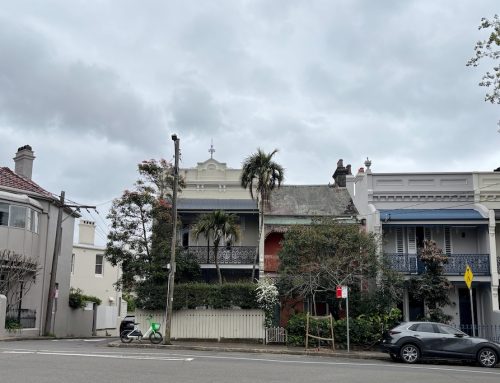
- Approximately 52% of the area is within a Heritage Conservation Area and the precinct includes more than 240 heritage items.
- Council identifies 310 contributory buildings directly affected, 191 of which could be demolished.
- The alternative approach integrates heritage listed items whereas the State’s rezoning will allow podium and tower forms which will overwhelm individual heritage items.
Tree canopy and environment:
- The area currently has a canopy coverage of 32%.
- Council’s canopy target is 30% and now the Sydney Plan target is 40% by 2036.
- Council estimates that around 25% of existing canopy could be lost or significantly affected—almost 1 hectare or more than 900 established trees.
- This is at odds with the State government’s claims that canopy can be maintained at 30% within the precinct.
- It means the 40% canopy cover by 2036 called for in the Sydney Plan will never be realised in Woollahra.
- Council’s alternative approach would result in only 2% canopy loss alongside a heavily mandated replanting scheme.
- Ask why Woollahra will be prevented from achieving the 40% Sydney Plan target, as well as Council’s own 30% target.
- Point out that the proposal will increase the heat island effect, negative urban cooling and increase localised flooding; all factors that will be exacerbated by the changing climate.
- Ask that any rezoning address the impacts of climate change, mandate enforceable tree-retention and canopy targets, adequate setbacks and protection for steep, flood-prone and environmentally sensitive land.
Economic feasibility and housing outcomes:
- The State’s own assessment says the proposal creates theoretical capacity for 9,000–10,000 homes but forecasts delivery of only around 4,800.
- It acknowledges that development may be feasible “on paper” but that not all sites will be developed. It also expects a premium residential market and acknowledges that new dwellings are likely to be expensive.
- Ask the Government to publish the underlying feasibility modelling and demonstrate how the proposal will deliver genuinely diverse and affordable housing.
Delivery of Woollahra Station:
- The rezoning depends heavily on the proposed station, yet the proposed $15,000-per-dwelling transport levy applies only within the Woollahra Station catchment and is subject to further feasibility testing.
- Even if it applied to all 9,400 theoretical dwellings, it would raise only $141 million—less than the approximately $150 million estimated cost of constructing the station.
- Based on the State’s own forecast of 4,800 dwellings, it would raise approximately $72 million.
- Ask for a firm funding commitment, published timetable and guarantee that the station will open in 2029 (as the Minns government has promised) before rezoning proceeds.
Why this matters
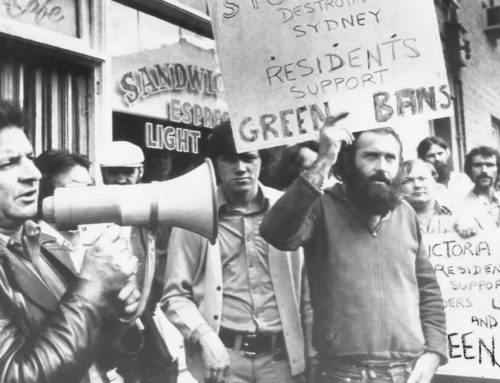
- Ten years ago, our community fought the proposed council amalgamations to protect Woollahra’s character and preserve local planning decision-making. Although the mergers were stopped, the NSW Government subsequently removed important development-application powers from councils.
- This new fight matters even more. Now the State government wants to rezone our area for the worse. If the rezoning proceeds in its current form, it will completely rewrite Woollahra—replacing its leafy streets, heritage character and established built form with large-scale high-rise development.
- If approved the proposal will place further pressure on existing open-space and hard-infrastructure deficits, worsen traffic congestion throughout Woollahra and surrounding areas, and threaten existing lower-cost housing. All this could occur without a clear, legally binding guarantee that Woollahra Station will ever be completed and opened.
- This is not an argument against housing. It is an argument for planning that respects the place, protects its character, delivers infrastructure and ensures that growth is realistic, properly funded and supported by transport.
For information about the future Woollahra Station, visit the project website or contact Transport for NSW via email at projects@transport.nsw.gov.au or by phone on 1800 684 490.
Woollahra Municipal Council Alternative Approach
Woollahra Municipal Council have shared their alternative to Government rezoning for Woollahra & Edgecliff. Find out more about Council’s alternative to the government’s rezoning plans for Woollahra and Edgecliff. Mayor of Woollahra, Councillor Sarah Dixson, together with Council staff, have developed an alternative approach to the state government rezoning plans for 10,000 new dwellings in Woollahra and Edgecliff.
Woollahra Council’s Alternative Approach to the State Led Rezoning document outlines plans for the area to accommodates up to 3,600 dwellings and is based on transport, economic feasibility, social infrastructure and urban design studies and comprehensive technical investigations which address the precinct’s geographical, environmental and heritage setting while maintaining the qualities that define Woollahra and Edgecliff.