An Interview with Grahame Bond
Paddington resident Grahame John Bond AM (born 21 November 1943) is an Australian architect, actor, writer, director, musician and composer, known for his many characters including Aunty Jack and The Ancient One in the first two seasons of the Beastmaster. Judy from the Society recently caught up with Grahame and his partner Kate.
“Watch your back, son. You’re in Paddington”, Grahame Bond’s father would warn him in the 1950s as they walked together down Glenmore Road. They lived in Marrickville and would catch the Bondi tram to Paddington to meet his father’s friend Mickey Thomas in William Street to go watch the South Sydney Rabbitohs at the SCG. Paddington at the time was not the suburb it is today. It was rougher, less predictable, and not especially desirable. People paid attention to where they were.
Grahame remembers it fondly. “There was a real sense of risk at night, and the distinct smell of night soil lingered in parts of the suburb,” he says. Years later, Bond would become widely known as the creator and performer behind the television character Aunty Jack, whose famous threat — “I’ll rip your bloody arms off” — captured a kind of exaggerated menace that, while comic, wasn’t entirely disconnected from the vibes of mid-century Paddington.
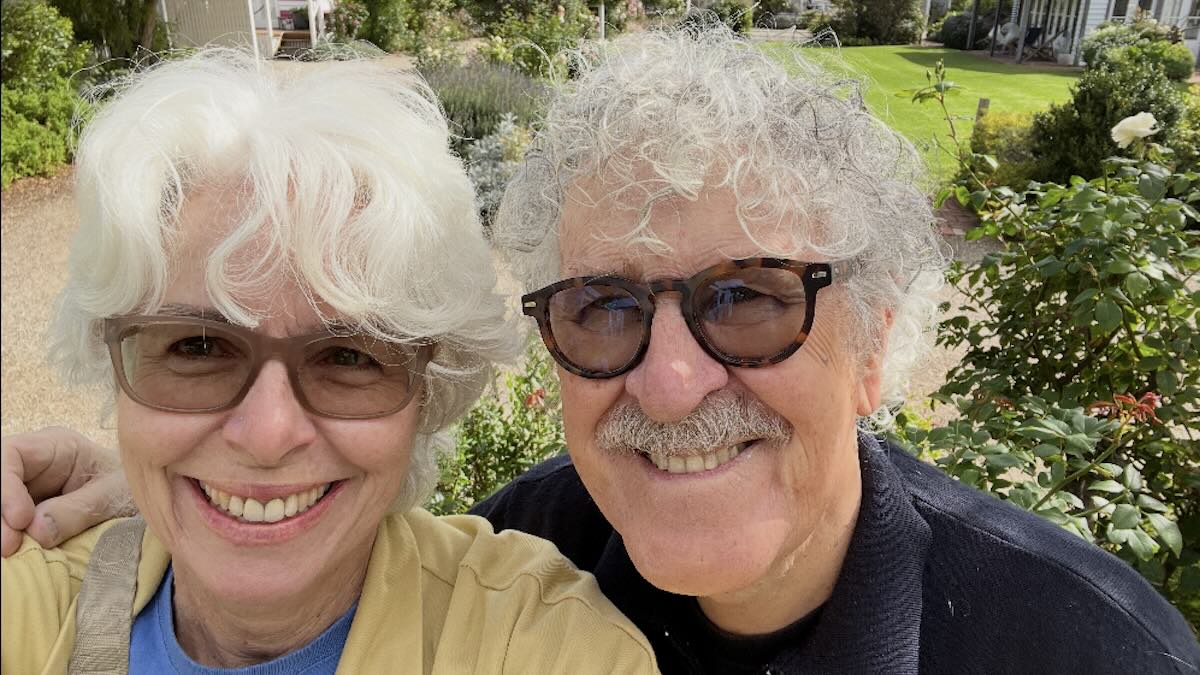
Kate Parker and Grahame Bond, South Australia, 2026
Grahame’s connection to Paddington spans decades, but it was not until 2001 that he and his wife Kate Parker made it their home. By then, both had lived elsewhere in Sydney: Grahame in Darling Point and Kate in Redfern, and they settled in Paddington as a practical midpoint. They had married in 2006 with a service conducted by Janet Morice, a long-time resident and historian in Paddington Village.
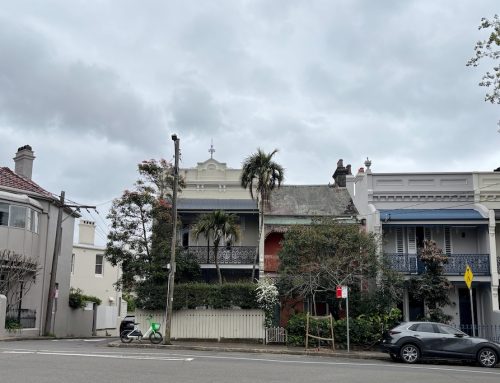
Grahame and Kate and her son moved into a terrace built in 1891, still bearing the name J.B. Quigly on its façade, a remnant of its earlier life as a corner store. The building is irregular in the way many Paddington buildings are: “Nothing is quite straight, walls and floors slightly out, furniture difficult to place”, says Grahame. “There are indications that the shop once extended into the neighbouring property, possibly through an opening in the wall. There was likely a large display window to the shopfront, with traces still visible.”
“It’s a very happy house,” Grahame says. “And it’s flooded with northern light.” “It’s a wonderful home,” Kate adds. They became known to their friends as “the Quiglys.”
Kate’s own connection to Paddington began in the 1980s, when she moved from Queensland to study art at East Sydney Technical College. She lived in a large share house on Elizabeth Street at a time when the suburb was still relatively affordable.
Grahame says “Paddington at the time was full of artists and students, and had a really strong gay community. That’s what changed Paddington,” he says, noting similar shifts in Newtown and Leichhardt.
The cultural life of the suburb at that time was active. Grahame and Kate speak fondly of art galleries that operated in terraces and warehouses—Mary Place Gallery (now Defiance), Hogarth Galleries in Walker Lane, and Barry Stern Galleries on Glenmore Road, later Maunsell Wickes. Cinemas such as the Academy Twin, the Chauvel and the Verona, now all gone, were part of everyday life.“It felt very local,” Kate says. “You didn’t need to leave the suburb.”
Kate’s family also became connected to the area. Her mother later lived in Gipps Street, near Gallery A, a ground-breaking art gallery which occupied the old police station and was run by a family friend.
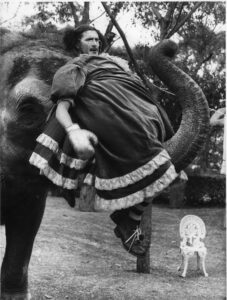
Aunty Jack and Colin the elephant, 1973
By the time Grahame and Kate moved into their house in 2001, Paddington was already changing, although it was not entirely settled. “As I made an offer on the house, two young guys were climbing back over the fence having cased the joint,” Grahame recalls.
Their neighbours at the time were blue-collar workers, many from Greek and Maltese backgrounds. Over time, professionals moved in, mainly from the banking sector. “For a while we called it Wall Street,” Grahame says. Kate says there has been a slight shift since then “Now it’s more young families,” she says. “We have always had great connections with the neighbours.”
Over the years, they have seen a number of changes in the streetscape of Paddington, most small but significant. “Dunny lanes” in the street were reclaimed by residents after encouragement by Council and with expert guidance by paralegal and Paddington resident Laelie Schwartz,” Kate says. “It doesn’t sound like much, but gaining those extra few metres changed how the houses work.”
There was also a community effort around what is now the Royal Hospital for Women Park. Early residents of the adjacent development had assumed it would function as a private space, flanked by an old wall that ran down Brown Street. The residents campaigned for the removal of the wall, ensuring it was opened up as a public park.
Oxford Street itself has gone through cycles. Kate observes “There was a period of decline, but in recent years it has improved, particularly with the opening up of restaurants. It’s much better than it was, although we could do with a good local deli.” Local restaurant favourites include Mr Ts at Five Ways, Il Baretto and the Bonython Café.
Some elements of Paddington have changed significantly. The cinemas have gone, and retail has shifted upmarket. What remains are the buildings. “The elegance of the buildings, the history and the proportions, that’s what holds it together,” Grahame says. “The proportions of terraces are very, very good.”
Paddington has long attracted architects. Grahame studied architecture at the University of Sydney in the 1960s and was closely involved in the Architecture Revue, organising the “Noddy Super Ball” at Paddington Town Hall. “It was quite an event,” he says. “Five bands performed, at times all at once. We raised $5,000, which was a lot at the time.” One of the performers was Rory O’Donoghue, beloved by television audiences and a long-time friend and collaborator of Grahame’s.
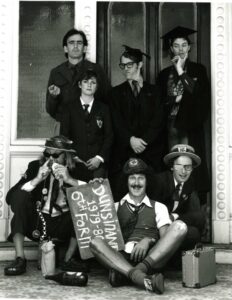
Cast of Boys Own McBeth, 1973 (Top row: Paul Johnstone, Elizabeth Wilder, Kym Gyngell, Graham Matters. Bottom row: Nick Lyons, Grahame Bond, Bjarne Ohlin)
After graduating as an architect and briefly tutoring in design, Grahame worked in a collaborative studio of architects and designers, “an atelier,” as he describes it, with people including Brian Zulaikha, whose later work included the cinema at the Verona. But very soon, Grahame returned to performance and writing.
Grahame became widely known through television, radio and stage work, including The Aunty Jack Show, and later productions such as Boys Own McBeth and Captain Bloody. In 1990, he established the advertising agency Bond Strohfeldt. He created well known jingles and lines such as “There’s no other store like David Jones”. He sold the business in 1996 and travelled extensively. One of his favourite destinations was Papua New Guinea.
When they moved to Paddington, Grahame was a presenter on Better Homes and Gardens, and had a recurring role as The Ancient One in the Australian-Canadian-American television series Beastmaster.
Grahame is now retired and Kate continues her art practice and recently exhibited in a group show in Glebe. Paddington today is more polished and significantly more expensive than the suburb Grahame first encountered. The sense of risk has largely disappeared. “It’s a very sociable street,” Kate says. “That hasn’t changed.” What remains is a place where its history is still visible in the buildings, the streets, and the patterns of change over time.
As told by Grahame Bond and Kate Parker to Judy Hitchen for The Paddington Society, Paddington, 16 March 2026