The Sydney Dance Company was conceived in Paddington by dancer Suzanne Musitz and her husband Frank Davidson. The couple bought their small terrace at 1 Norfolk Street, Paddington in 1967 as the suburb was rapidly becoming a home for the arts. Many streets were still working-class while others were filling with young teachers, artists, dancers and architects who could afford the housing.
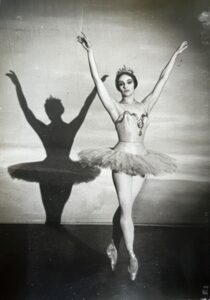
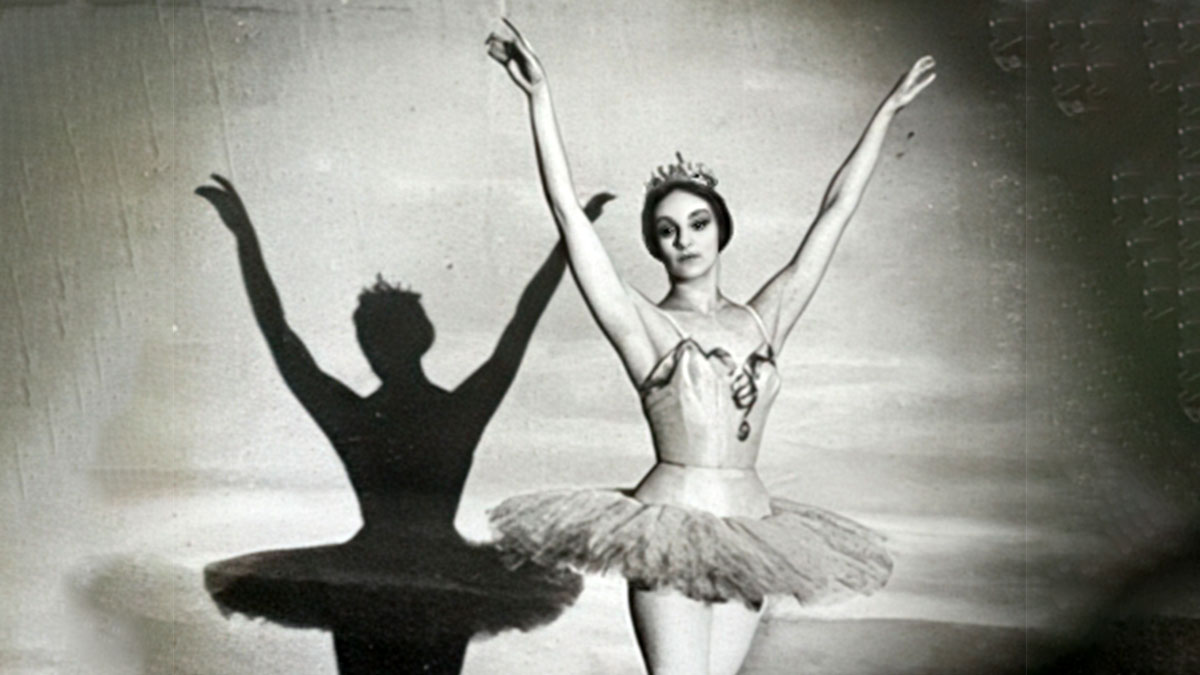
Suzanne Musitz; source Frank Davidson
“I always had a longing to live in Paddington for some reason,” said Frank. “I remember when I was about 8 or 9, on a visit to Sydney from the country with my mother and she was pointing out the features of the city. I looked towards Darlinghurst and Paddington and asked, ‘what are those places?’ to which she replied, ‘Oh, those are the slums, darling.’ Somehow her tone of disapproval seemed to make them interesting. Years later when Sue and I had bought our first house, we had to explain to our families that £6,000 was all we could afford.”
What began as a simple home for a newly married couple soon became the starting point for one of Australia’s most enduring cultural enterprises.
From Sydney to London and Back Again
Suzanne’s love of dance had previously carried her well beyond Sydney. Trained by Joan and Monica Halliday, early advocates for Australian ballet, she was discovered as a schoolgirl by Czech master Edouard Borovansky, a Czech-born Australian ballet dancer, choreographer and director. After touring with Anna Pavlova’s company, he and his wife Xenia settled in Australia where they established the Borovansky Ballet company. ‘Boro’ was artistic director of what was the only professional ballet company in Australia at that time. After his death, John McCallum, a director of JC Williamson’s, which had been the company’s main support, contacted Ninette de Valois. She suggested Peggy van Praagh as a potential artistic director for a new ballet company. The Australian Ballet Company was established in 1962.
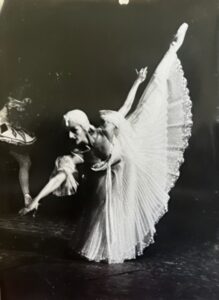
Suzanne Musitz as “Prayer” in Copelia, The Australian Ballet, 1962; source Frank Davidson
In 1955 aged eighteen, Suzanne had sailed alone to London to study at the Royal Academy of Dance, later performing with the Marquis de Cuevas International Ballet in Europe. There she developed an expressive, dramatic style that became her hallmark. Suzanne went on to join the Western Theatre Ballet (later re-named the Scottish Ballet) under Peter Darrell, earning recognition for her role in The Prisoners. “I wasn’t a pretty girl,” she said. “I was a dramatic ballerina, good at being either very funny or very scary.
In 1962, van Praagh persuaded the young dancer to return home and join the Australian Ballet Company. Suzanne danced in the company’s debut season in 1962, performing in the full-length Swan Lake. The repertoire also included Coppélia, in which Suzanne performed the Prayer solo. In the audience was Frank Davidson, who attended with mutual friends. Suzanne and Frank were married three years later, on April 3, 1965.
A Company Takes Shape on Norfolk Street
When the couple settled in Paddington, Suzanne’s love of ballet met Frank’s love of teaching. Frank had begun his career in high schools and was lecturing at Sydney Teachers’ College where he took on a role as director of the Sydney Educational Drama Laboratory.
Suzanne had long wanted to satisfy two aims – to give dancers additional opportunities for professional employment in Sydney, and to educate the public on this art form. In 1969, encouraged by Peggy van Praagh, their Paddington terrace became the headquarters for Ballet in a Nutshell, a name suggested by Peggy. This group was a small troupe of dancers Suzanne had selected from the Australian Ballet School. Together with a pianist, they performed at schools, Rotary Clubs and regional theatres across New South Wales.
“We were doing it all ourselves,” Suzanne recalled. “The company office was set up in our spare bedroom and a lady who lived locally would come every day to do the bookings.”
As the troupe grew, ultimately to 26 dancers, it took on a new name. A Penrith headmaster, when offered the program, told Suzanne that his boys would not come to anything called “ballet”, so based on what the program presented, she renamed it Athletes and Dancers. Meetings to formalise the group’s structure were held around the Davidsons’ dining room table in Norfolk Street. The group’s first professional performances were planned from that same address.
When Frank Barnes, General Manager of the Sydney Opera House, invited Suzanne to create a program for the opening night of the Opera House in October 1973 she was astonished. “But this isn’t a company,” she told him, “it’s just a little group of artists.” In order to put together the Opera House program, premises including room for three studios, a wardrobe department and offices were donated by the property developer Sid Londish. A new identity was also needed, and so The Dance Company (NSW) became the group’s official name, marking the beginning of what would later become the Sydney Dance Company.
The combination of creativity and resourcefulness would remain at the company’s core.
Paddington back in the 1960’s
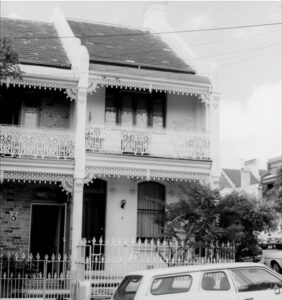
1 Norfolk Street, Paddington; source Local History Digital Archive, WMC, 1982
Paddington streetscape of the 1960s had been a curious mix of the old and the recently restored. Frank Davidson laughed as he recalled, “When we arrived, all the houses were the same colour – brown! In later years they were every colour you could imagine.”
The Davidsons had bought their small three bedroom house from an investor who had been renting it to a fireman with five children. The Davidsons’ neighbours included Mrs Bruhn, a volunteer at Glenmore Road Primary School tuck-shop; an elegant hairdresser; and Harry Pitt the bus driver, who once steered his green double-decker up Norfolk Street to drop his wife home with the groceries. Across the road, theatre people and architects were reviving tired terraces, reflecting the suburb’s creative energy.
On one memorable afternoon, Suzanne staged a dance from Swan Lake on the footpath outside their house. Four women from the Business and Professional Women’s Club, dressed in white tutus, performed as amused neighbours watched from their balconies. “It was really for the girls themselves,” she said, “but it stopped the street.” The performance captured the spirit of Paddington at that time: informal, inventive and full of enthusiasm for the arts.
Elizabeth Street and the Chocolate Factory
By the early 1970s, with two children Mark and Millie, the Davidsons bought a larger terrace on Elizabeth Street owned by a Greek tailor Mr Melianos. The house was originally a five-bedroom free-standing villa called “Warialda” which, as Paddington developed, had terraces built against it on both sides, so that it blended into Paddington’s terrace streetscape. It was opposite Wladyslaw Pulkownik’s “Paddington Chocolates” where exclusive delicacies were made, as well as sold. They recalled regularly walking across the street with a silver salver to have it filled with handmade chocolates that were often wrapped by local children after school for a small payment.
When asked to recall if there were any events they remembered from that time, Frank said: “At the top of Elizabeth Street was a big old-fashioned Woolworths. After one heatwave in the middle of summer, everything went off and the shop closed, never to reopen.”
From the Elizabeth Street house, Suzanne continued to manage The Dance Company, commuting to studios at 10 Parker Street near the Capitol Theatre. Both Suzanne and Frank were amongst the earliest members of The Paddington Society, campaigning for the protection of the suburb’s heritage as redevelopment pressures intensified. “It was a very important group; we all felt Paddington had to be protected,” said Frank.
From Paddington to the World Stage

Promotional Material, The Dance Company (NSW); source Frank Davidson
The Dance Company eventually outgrew its Paddington home, moving to larger rehearsal spaces as it gained national recognition. In 1979, under artistic director Graeme Murphy and his partner Janet Vernon who had danced in the original touring group, the company adopted its defining new name, the Sydney Dance Company and this pair went on to lead it for a remarkable 30 years. Yet its roots remained unmistakably local: a humble Paddington terrace filled with music, determination, and the belief that the people of New South Wales would embrace dance.
Today Sydney Dance Company reaches far beyond the work of its leading performers, fostering a broad and inclusive dance community. Guided by a belief in the universality of dance, the company offers Australia’s largest public dance class program inviting people of all ages to discover the grace, strength and creativity within themselves. Its national education program provides a structured pathway from primary and secondary school students through to pre-professional dancers and university graduates, nurturing the next generation of Australian artists.
Suzanne and Frank lived in Paddington for more than fifty years, and loved its bohemian community. “I loved Paddington when we first arrived. There were people like us – our age, our background and with an involvement in the arts.”
From the wooden floors of a small Paddington terrace came not just a dance company, but an introduction to ballet for many people in Australia and ultimately an introduction to Australian dance for many people around the world.
As told by Suzanne and Frank Davidson to Judy Hitchen for The Paddington Society, Normanhurst, 13 October 2025.